Selling on eBay Australia can be an excellent way to reach customers, but getting the sale is only one part of ecommerce.
The real challenge begins when a customer wants to return an item.
A returned product has to be received, inspected, recorded, and either returned to sellable inventory, repaired, repackaged, discounted or written off. For sellers processing dozens or hundreds of orders every month, managing these tasks manually can quickly become expensive and time-consuming.
That is where an organised eBay returns process and a reliable Australian fulfilment partner can make a significant difference.
In this guide, we'll explain how eBay returns work in Australia and how sellers can manage returned inventory more efficiently.
How Do eBay Returns Work in Australia?
eBay sellers need to establish a return policy for their listings.
When a seller accepts returns, the policy should specify important details such as the return period and who pays return postage. eBay requires sellers to honour the return policy they publish on their listings.
However, there are situations where a seller may still need to accept a return even if they do not normally offer change-of-mind returns.
For example, when an item arrives damaged, is faulty, doesn't match the listing description or the wrong item was sent, the buyer may have protections under eBay's policies.
This is why Australian eBay sellers need a returns process that goes beyond simply issuing refunds.
The Problem With Managing eBay Returns Yourself
Imagine your ecommerce business receives 100 orders every week.
Even if only a small percentage are returned, you may soon have products arriving back at your home, office or warehouse.
Now you need to answer questions such as:
- Has the item actually been returned?
- Is it the correct product?
- Is it still in sellable condition?
- Is the packaging damaged?
- Are accessories missing?
- Should the item be restocked?
- Does it need repackaging?
- Should it be discounted?
- Should it be returned to the supplier?
- Has the customer already been refunded?
Without a structured system, returned inventory can quickly become difficult to track.
A Better eBay Returns Process
A professional returns process should have clear stages.
1. Receive the returned item
The first step is receiving the product at your nominated Australian return address.
A fulfilment warehouse can receive returned parcels on your behalf instead of requiring customers to send products directly to your home or office.
2. Identify the order
The return should be matched with the original order.
This helps establish:
- Customer order
- SKU
- Quantity
- Original sale date
- Return reason
- Tracking information
- Refund status
3. Inspect the product
The returned item should be inspected before it is placed back into inventory.
Check:
- Product condition
- Packaging
- Accessories
- Manuals
- Labels
- Serial numbers where applicable
- Signs of use
- Visible damage
4. Classify the returned inventory
Not every return should automatically go back into sellable stock.
A useful classification system could include:
A — Resellable
The product is unused or in excellent condition and can return to normal inventory.
B — Repack Required
The product is usable but needs new packaging or preparation.
C — Damaged
The product cannot be sold as new and may require repair, clearance or disposal.
D — Missing Parts
The product is incomplete and needs further investigation.
This simple classification can make inventory management much easier.
What Should You Do With Returned Products?
Once an item has been inspected, you need to decide what happens next.
Restock
If the item is in sellable condition, return it to available inventory.
Repackage
If the product is fine but the packaging is damaged, it may require new packaging before being sold again.
Repair
Some products can be repaired and returned to inventory.
Clearance
Products that cannot be sold as new may potentially be sold through another channel depending on their condition and your business model.
Return to Supplier
If your supplier accepts defective or damaged inventory, returned items may be consolidated for supplier returns.
Dispose
Products that are unsellable may need to be disposed of according to your business procedures and any applicable requirements.
Who Pays for eBay Return Postage?
The answer depends on the reason for the return and the seller's return policy.
If the buyer simply changes their mind, responsibility for return postage depends on the seller's stated return policy.
However, if the item is faulty, damaged or doesn't match the listing description, the seller may be responsible for the return postage under eBay's policies.
This makes accurate product descriptions and quality control especially important.
How Long Do eBay Sellers Have to Respond?
When a buyer opens a return request, eBay states that sellers generally have 3 business days to respond and resolve the issue. In some cases, eBay may automatically accept a return request depending on the circumstances.
For sellers handling a large number of orders, having inventory and returns organised can make it easier to respond quickly.
How a 3PL Can Help With eBay Returns
A 3PL provider can become the operational link between your customers and your ecommerce inventory.
Instead of receiving every return yourself, your 3PL warehouse can:
Customer
↓
Return shipped to warehouse
↓
Warehouse receives item
↓
Product inspection
↓
Condition recorded
↓
Restock / Repackage / Hold / Dispose
↓
Inventory updated
This allows the seller to focus more on sales, marketing and business growth rather than handling every returned parcel manually.
eBay Returns and Inventory Management
Returns should not be treated as a separate process from inventory management.
Every returned item affects your stock levels.
For example:
If you sell 500 units and receive 20 returns, those 20 products need to be accounted for.
If 15 are resellable and 5 are damaged, your inventory system should reflect that difference.
Poor returns management can lead to inaccurate inventory numbers and situations where a seller believes they have stock available when the physical product is actually sitting in a returns area.
How to Reduce eBay Returns
The best return is often the one that never happens.
Australian eBay sellers can reduce avoidable returns by:
Use accurate product descriptions
Clearly explain product dimensions, materials, specifications and compatibility.
Use high-quality photographs
Photos should accurately represent the product.
Check products before dispatch
A simple quality-control check can identify damaged or incorrect products before they reach the customer.
Pack products properly
Strong packaging helps reduce damage during transportation.
Pick the correct SKU
Sending the wrong variation is an easy way to create an unnecessary return.
Keep inventory organised
Accurate stock records reduce overselling and fulfilment mistakes.
eBay Returns Are Also a Customer Experience Issue
Returns aren't necessarily bad for your business.
A simple, professional returns process can give customers confidence when purchasing from your store.
eBay itself highlights returns as part of the overall after-sales experience and provides sellers with tools to create and manage return policies.
The important thing is making the process predictable.
Customers should know what to do, while sellers should know what happens to the product once it comes back.
How OZ Prep Services Can Help
As your eBay business grows, managing orders and returns from your own location can become increasingly difficult.
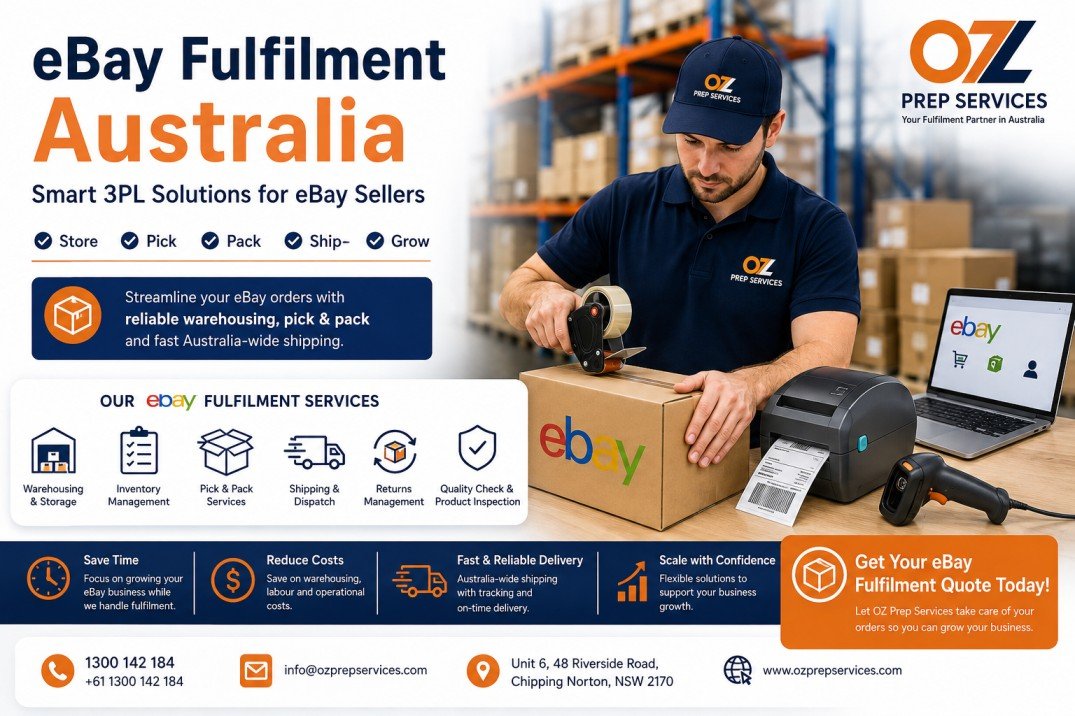
OZ Prep Services can provide Australian warehousing and fulfilment support for ecommerce sellers, helping businesses manage operational tasks such as:
- Inventory receiving
- Warehousing
- Pick and pack
- Product inspection
- Repackaging
- Order fulfilment
- Returns handling
- Inventory management
- Kitting and bundling
With a structured warehouse process, returned inventory can be inspected and processed rather than simply sitting in a pile waiting to be checked.
Final Thoughts
eBay returns are an unavoidable part of ecommerce, but they don't have to become an operational headache.
The key is to create a clear process:
Receive → Identify → Inspect → Classify → Restock or Repackage → Update Inventory
For small sellers, managing this process internally may be possible.
For growing Australian ecommerce businesses, outsourcing fulfilment and returns to a 3PL can free up valuable time while keeping inventory organised.
If you're selling on eBay Australia and need help with warehousing, fulfilment, inventory or returns management, OZ Prep Services can help you build a more efficient ecommerce operation.
Need Australian eBay fulfilment and returns support? Contact OZ Prep Services today.